Saturday, February 17, 2007

Lenten Project


We aim to use Lamentations as the basis for creating a -
"House of Sorrows" at our Roslyn Church as we journey through Lent we are looking to use this website to make some posts, but also have some interactive response that allows us to create this House of Sorrows for this season. We want people to feed in prayers, stories that show us something of the 'lament' in our present world. Ideally, we'd like to hear from places where the voice heard is more first hand.We would also like it if you could post to us a small piece of cloth/rag that we may set your poem/story beside and place in the House of Sorrows which we hope will become an installation that can give voice to lament and be a place for offering prayers of Hope. ( we can give you the address)
for more go to our Lament Blog:http://lament.highgatemission.info/index.html

Friday, December 29, 2006

Christmas Day


Christmas Day came with 'Surprises' out of boxes all wrapped up. Children had great fun and adults as we ripped them open and we sang or prayed or read the story. It gathered up all our advent journey as you can see here.
Amazingly, though I didn't realise it at the time, the sun was shining right on the manger!
So we got excited at the surprises we opened, the surprises of the story... shepherds turned up... and Mary pondered these things in her heart. So we took some time to ponder too.
A church full and a wonderful part of our day!

Saturday, December 23, 2006

As it is in Heaven

For some time now we have wanted to catch this movie. Finally managed it last night. Our little local cinema The Metro is great for good qusality little films. I rarely see Hollywood these days.


The story is simple. It doesn't have glamourous cast, nor glitz, no complex twists and turns. Rather it has evertything of the everyday, the complexities are in the individuals and their daily lives. It shows the scenic remoteness of the village in Norrland, northern Sweden. You can check out a synopisis elsewhere, but the main character is complex and 'strange' really, but his is a search like all the others amidst a social-cultural context where each is bound up and gagged in a range of ways. Also the past that binds them too. You can at times feel the intensity of it. perhaps that's because it is all too real. The closedness of the small village, the church, the choir. The minister is an interesting and inwardly eaten up guy just like the rest and tortured by his understanding of faith. There are some good lines too as liberation comes for each one of them, though not without pain.

Daniel (Michael Nyqvist), a successful and talented conductor, who returns the rural village he grew up in, to recover from a heart attack. No one recognizes him because he had changed his name many years ago. Soon, he is approached to lead the local church choir. As he confronts his own past demons, love comes in the form of one of the choir members, Lena (Frida Hallgren), who helps him to find who he really is. His return though sees him alone in the midst of winter in the village. As he encounters people, he is asked to come lead the choir. He refuses, but is often heard say 'I am here to listen'. I think there is something profound in those words when we go anywahere new and meet new people.

It is its simple story about the beauty of life that makes this film a gem. The music isn't bad either and the scenery all come together and engage your emotions.

I can only agree further with the following comments:
Another thing the audience may have problems with is the simple
characterizations in the film. Everyone has a straightforward role – the
teacher, the artist, the priest, the abuser, the abused, the messiah, the bully;
everything appears so clear-cut and one-dimensional. But, there is so much
honesty in them that their petty differences seem to be a stark reflection of
our own lives.
To top it all off, the film features some truly moving scenes
which will leave you mesmerized with the beauty of music and on a deeper level,
life. Other than the obligatory final inspiring scene, another gorgeous sequence
to look out for is when the abused wife, Gabriella (Helen Sjöholm), sings a song
specially written for her. One of Sweden’s biggest musical stars on stage,
Sjöholm’s voice will enchant the cynic in you.
Sure, there are no loud
explosions and no fancy computer generated effects to draw in the average
movie-goer. But do yourself a favour, watch this film, experience the beauty of
life, and you will take home a piece of heaven with you.

Friday, December 22, 2006

Planting and tending lessons

At our mid-week Caim this Spring (NZ time) we set about a garden ministry. Each Saturday morning we took on a garden and dug veggie plots, went back and planted seeds or seedlings, or simple weeding and tidy up.

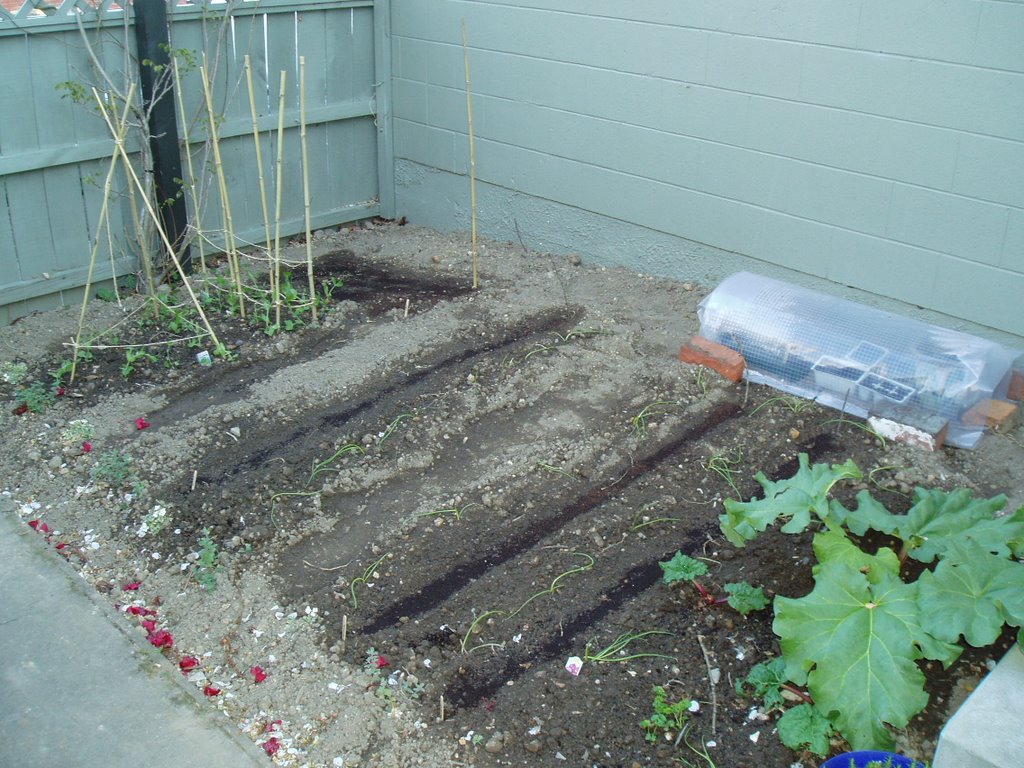
Closer to home, I decided this year to plant some veggies too. It started something looking like this -

sugar snap peas, sweet corn(!), lettuce, Rocket, beetroot, broccoli, red onions, carrots, parsnip, and butternut squash.
a venerable harvest to share around with friends and neighbours.


In a time of huge ministry change for us all at Highgate, but also myself, the little garden plot has served to remind me of Peterson's 'Under the Unpredictable plant' where he uses a gardening image for ministry.

I confess it has helped me through the past months and weeks since Martin just left a few weeks ago. tending these plants, just enough shelter too as it has even hailed recently, delicately taking out the weeds and watering as required... all the gentle reverence for pastoral care.


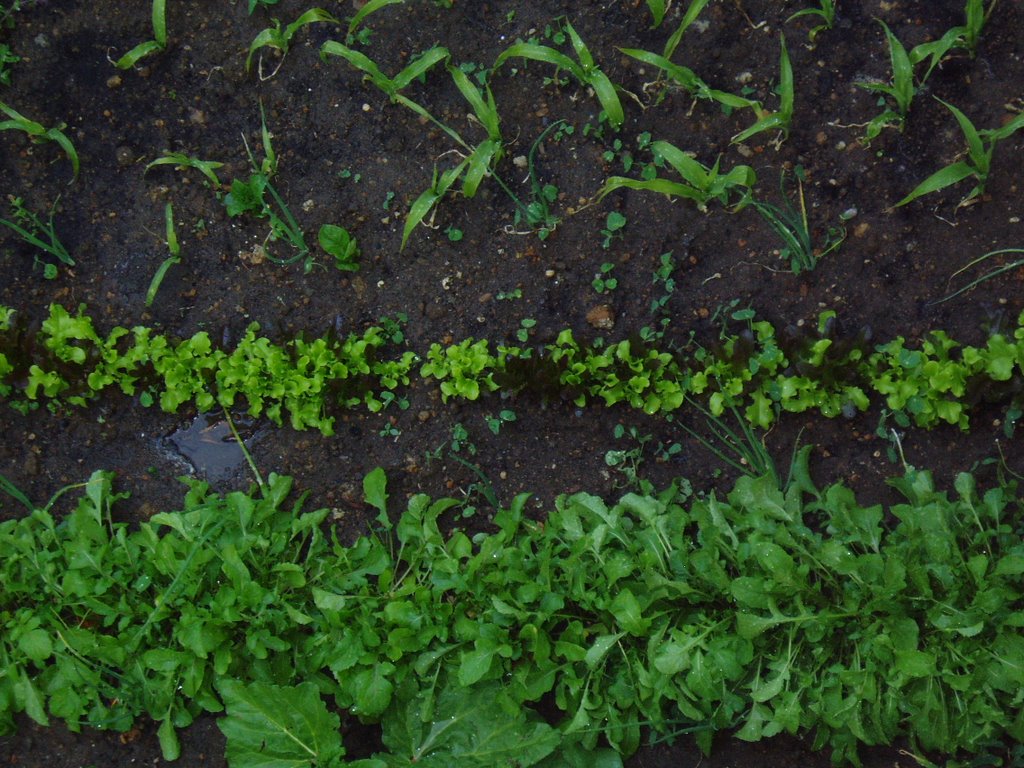
So here is a recent update on my patch. See how they grow. It was hard holding back at that crucial stage of simply placing the seeds in the soil. Waiting and waiting and waiting.

With some thinning out some should grow even more, but I hope to harvest some lettuce and rocket for making a fresh salad with plenty taste. Yum!

Thursday, October 05, 2006

Reading the Everyday


Having been reading and thinking and attempting, as last post, to find ways to get us to consider our 'embeddeness' in our locations in mission, I'm grateful to Paul Fromont for this via Maggi Dawn. Its an article in Thirdway Magazine from John Davies. (Though its much more too from his blog here.)

Monday, September 18, 2006

This familiar place?


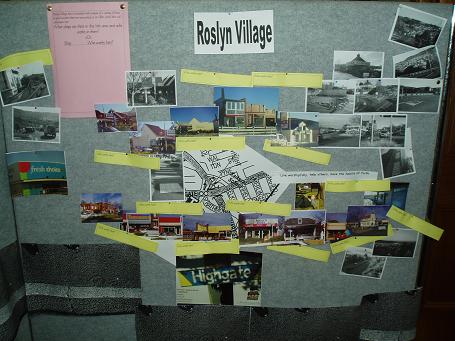
I came across a way of reading the local context which I adapted for our Annual Meeting purposes.

It is both a visual on the streets around us, buildings, as well as simnply noting which sde of the street people mainly walk on and why? to use of parks and are the seats comfortable, etc, etc. and there's a challenege to name the people who work in the cafes and shops along Highgate. A small challenge really.

Actually what I would love to do, and may yet again, is to get people to walk Highgate with an eye and sense of people movements and much more. It moves us beyond just looking to sensing. I liked that. Then we would display findings and discuss it in considering how we are embedded in this context and what locally could be improved in our environment, etc.

This is the bear bones of a method derived from the RSVP Cycles (Halpern and Halpern) Sadly, I cannot get my hands on a copy of this and so gleaned from the beb, but if anyone, knows anyone I could borrow from then it would be great to read that book.


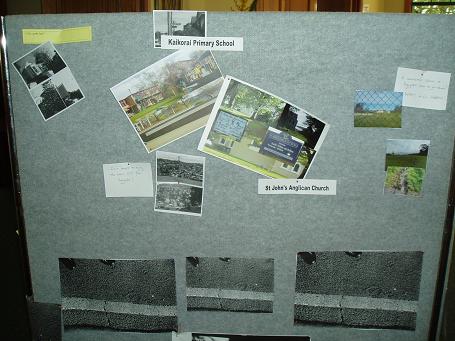
Interestingly, people using our facilitires and in the congregation have had curious interest too in the display in the main foyer area. Pre-school Music parents/grandparents and others. Mmmm!


I had loads of photos and comments and some fun bits for kids to find MArtin and/or me lying on benches hidden around the display. Also some fun photos from our youth along the way too. Also tried to note some changes to properties and in shop use etc. Lots of options to it really.


Friday, September 15, 2006

Moving through the silence


And so the blossom has started to burst in Dunedin! Took this today of the tree beside our house.

There is a great deal of change on Highgate just now and we're all in a spin as Martin is heading to Christchurch to a church there.

We have some big questions ahead in the next few months, but we need some thoughtful talk and dare I say it - silence - that helps us. I am reminded of this from Paul Fromont 'Benedict on Silence' which I have been pondering recently. (or from Anthony Hanson here)Given below.

"Silence is a cornerstone of Benedictine life and spiritual development, but the goal of monastic silence is not nontalking. The goal of monastic silence, and monastic speech, is respect for others, a sense of place, a spirit of peace. The rule does not call for absolute silence; it calls for thoughtful talk.... Silence for its own selfish, insulating sake, silence that is passive-aggressive, silence that is insensitive to the present needs of the other is not Benedictine silence.
Benedictine spirituality forms us to listen always for the voice of God. When my own noise is what drowns that word out, the spiritual life becomes a sham. Benedictine spirituality forms us to know our place in the world. When we refuse to give place to others, when we consume all the space of our worlds with our own sounds and our own truths and our own wisdom and our own ideas, there is no room for anyone else's ideas. When a person debates contentiously with anyone, let alone with the teachers and guides of their life, the ego becomes a majority of one and there is no one left from whom to learn. But Benedictine spirituality is a builder of human community. When talk is unrestrained, when gossip becomes the food of the soul, then destruction of others can't be far behind. When talk is loud and boisterous, when we make light of everything, when nothing is spared the raillery of a joke, the seriousness of all of life is at stake and our spirits wither from a lack of beauty and substance. Make no doubt about it, the ability to listen to another, to sit silently in the presence of God, to give sober heed, and to ponder is the nucleus of Benedictine spirituality. It may, in fact, be what is most missing in a century saturated with information but short on Gospel reflection. The Word we seek is speaking in the silence within us. Blocking it out with the static of nonsense day in and day out, relinquishing the spirit of silence, numbs the Benedictine heart in a noise-polluted world."

Joan Chittister, O.S.B., from her book (a translation/paraphrase of the Rule of St. Benedict, with her commentary) The Rule of Benedict: Insight for the Ages.

Friday, August 18, 2006

Readings 3

Spirituality in the City
Andrew walker (Editor) (SPCK 2005)
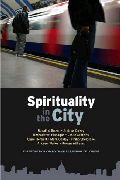


In this as so many areas, the education of the spirit is inseparably bound to highly practical challenges. If - as St Frances de Sales is supposed to have said - spiritual direction begins when people are helped to walk more slowly, talk more slowly and eat more slowly, then the life of the spirit in the city will entail asking about the size of rooms in public buildings, the flow of traffic on the streets, the levels of atmospheric pollution, the maintenance of parks, galleries and libraries, the space available for children in public - and countless other matters where decisions are regularly taken as though none of these could possibly be an issue. (Rowan Williams in Spirituality in the city, p24)

In recent times studies on space and place have seen an integration of the discussion of cities which usually focuses on planning, architecture, and economics, to incorporate the need to address the philosophical, theological, and spiritual aspects of cities. Albeit that this set of essays reflects much upon cities in Britain, this is still a very interesting little volume to read and reflect upon the every expanding city-scapes in New Zealand and the implications for faith. This book was specially commissioned by the London Centre for Spirituality and invites nine writers to help engage us with the nature of ‘spirituality’ and the urban environment of the city.
Each essay provides a different facet to spirituality in the city and offer more than a ‘sentimental’ celebration of the city. Rather, these essays are a serious attempt to understand ‘urban spirituality’ and a politic, if you like, of the built environment where insights of the work of God are discerned or made visible. So Mark Oakley writes of ‘Reclaiming Faith’ exploring the ‘intimations of the sacred –rumours of God’ (7,8) that shape faith in the city. Hence, each notes in their own way the ways in which ‘Urban life,… is at once dangerous and creative…’(R. Williams,17).
I especially appreciated essays from:
Rowan Williams, ‘Urbanisation, the Christian Church and the human Project’. Williams seeks to offer a ‘rough sketch’ of the themes and concerns that might inform an ‘urban spirituality’ with the role of the church needing some careful thought. Reflect upon the challenges he notes the use and organization of time, the question of ‘character’, life lived under the ‘sign of anonymous exchange’.
He tells us that:
We need to rescue spirituality from some of the ways in which it has been domesticated,. …. It becomes only a code for techniques of making people feel a bit better about themselves… where the Spirit makes people ‘uncomfortable about themselves and their environment, critical and creative, open to things being different. (24)
Williams wants a Church to know it has something distinct from the surrounding culture and yet has something distinct to offer society that is more humanizing.

Philip Sheldrake, ‘Cities and Human Community’; considering a theology of place, in particular aiming to hold together urbs (the physical place, buildings, etc) and civitas (people and their life together). HE offers a ‘perspective’ that considers the crisis of place engaging with writers such as Augustine, Sennet, and Augé. In regard to De Certeau he takes up the practice of the city and ‘resistance’ to systems that leave no room for otherness. In conclusion he notes some spiritual issues especially the city as a place of reconciliation.

Bernadette Flanagan, ‘Urban Spirituality, One size does not fit all’, provides an excellent overview of six models of contextual spirituality, based upon Stephen Bevans snapshots of the ways Christians go about exploring the presence of God in different contexts they find themselves in. Flanagan provides helpful insights to each model with examples. This is a very concise, yet provocative essay with wide theological and social awareness beyond ‘new ways of being church’.

Andrew Davey, ‘The Spirituality of everyday life’. HE asks what is so different about prayer/spirituality in the city? How does the urban context affect the way we pray; and vice versa? What strategies and practices might we adopt?
Davey notes ways in which our ‘Location is vital. The places where we live, work, worship and encounter others are an essential part of the formation of our spirituality and theology.’(106)While the context(s) may not be very conducive to spirituality he does admit that ‘Cities are places of possibility and encounter’ (108) in which congregations can create spaces.

Andrew Walker, ‘Urban Possibilities for daydreaming’. Seeks to take the prayer of Examen and explore the dynamics of this as a suitable and apt form of prayer to the demands and pressures of urban life. This essay is well worth consideration as it is easily applicable to adapt to any urban context and its challenge for reading the cityscape environment, but in relationship to God.
There are some repeated themes throughout and some essays will strike you more than others. While each writer is aware of the dangerous, more negative side of the city, on the whole each is hopeful of the city. I wonder about the marginal voices and what they might say about spirituality in the city and whether they might take us to other depths not greatly expressed in this work. Furthermore, this volume may have benefited from an attempt to draw out the common themes, and identify the agenda more clearly as a way to indicate ways forward. However, this is a worthy collection.

Wednesday, August 16, 2006

Readings 2

Church After Christendom

Stuart Murray (Paternoster 2004)


In this book Murray continues his helpful analysis of post-Christendom churches. Part 1 explores issues of ‘Shape’ taking Acts 11 v1-18 as a paradigm to consider the shifts from Christendom to Post-Christendom. The key question is How might the church emerge or evolve? Murray teases out the issues of belonging, believing and behaving after Christendom and the complexities of this. I especially found helpful the clarity of his analysis and critique of the notions of centred, bounded and fuzzy set models of how we understand church. In particular, he considers the degrees of alienation and the language we make use of here, e.g. Semi-churched, de-churched etc. Rightly, I think, perhaps because I personally have issues about such language, he states,

This language is problematic, not least in its omission of any reference to other faith communities and its Christendom-orientated assumption that ‘churched’ is the cultural norm, rather than a counter-cultural experience. And it categorises attitudes towards church rather than Christian faith.’(25/6)

There is a chapter that critiques matters of leavers and joiners, which picks up on the works of James Fowler, Alan Jamieson and others. Murray then explores matters of church emerging or evolving. In some ways this is irresolvable at present, but I did like the probing, questing and the search for wisdom that we might learn from both inherited and emergent church.

Part 2 takes Ephesians 4 as biblical paradigm and Murray wants to ask the question What kind of church can survive and flourish in post-Christendom? The chapters that follow explore mission, community and worship. Within each, Murray takes terms and phrases that have become common use language in today’s church scene eg. Maintenance to mission, institution to movements, etc.. Across these chapters he considers evangelism, church discipline, leadership, rhythms and resources. He concludes,

Post-Christendom is a new environment…Ephesians 4 envisages a church united in hope(v4) confident in its destiny (v13) and getting on with the simple day-to-day business of speaking the truth in love (v15) and doing works of service (v12). If the church does survive the demise of Christendom, it will surely be a church sustained by simplicity and hope. (231 italics mine)

I say yes to that. I reckon that this second book (to what is now a series) is an invaluable that should help us frame our questions better in the new environment we find ourselves in. I appreciated the deep challenge, yet the refreshing ways that Murray provides open, honest analysis and critique. I found I couldn’t put this book down. It is a book I will probably need to keep returning to.

Readings 1

Been a while, but among other things I have been looking and planning ahead to Advent out in the community and whatb this might be for us.(More on that later. I also undertook some reading of new books this past month. So I will offer some review/reflections.

Post-Christendom Church and Mission in a strange new world.
Stuart Murray (Paternoster 2004)

In this book Stuart Murray seeks to move the discussion out of post-modernity/ism and to explore the other term that has become part of our vocabulary in recent times ‘Post- Christendom’. Murray offers an interesting perspective and seeks to make a case for ways the Church should respond to its changing status in society. He highlights key moments that were significant cultural and theological shifts that impacted the church’s mission for centuries. There is actually a necessary, though lengthy, historical introduction which helps set the context for his discussion. In the whistle-stop historical tour we move from the coming and expansion of Christendom where Augustine is figured as the significant figure in the Christendom shift, to the disintegration of Christendom, where Murray is particularly looking at the Reformation. In his reading of the reformers he states that ‘they introduced important changes but did not challenge the Christendom mindset’. Hence, as Murray points out; oaths, infant baptism, tithing, just war, use of Scripture to support the dominant culture, Old Testament taking precedence over the New, the marginalizing of Jesus, a ‘clergy caste’ who ‘performed services’ and an increased ‘dominance of monologue preaching’ and the operating with a ‘hermeneutic of order’ rather than justice, concern with church discipline, all reflect how the Reformers ‘hoped to transform society from the centre, but challenged none of the essential components of Christendom.’
It is perhaps at this juncture Murray’s Anabaptist perspective radically prods at those of us who are of a reformed tradition or background. Nonetheless, the book highlights how inaction, denial or hope in out-moded revivals are simply no longer options and calls for the church to accept that radical change is needed in all areas of mission and ministry. Indeed, it shows how a new mindset is required for actually 'being' church.
The legacy of Christendom in the vestiges and mindset that persist – ecclesial and social, Murray outlines some responses that we need to move beyond – denying, defending, dismissing, dissociating, demonizing, disavowing, disentangling, deconstructing, disembarking.
For all Christians concerned with the present and very real issues, Post-Christendom is an informative, hopeful and important account. However, its historical introduction, whilst necessary for setting the book in context, is overly critical and lengthy, and the book as a whole does perhaps betray a particular historical reading. Nevertheless, this does not undo the worthiness of this book.
The final chapter as he acknowledges, is not so much about resource answers, as matters of keeping on questioning. In conclusion, it rests upon a fresh encounter with Jesus at the margins of church and society, ‘since that is where Jesus is so often found’.
The helpful thing as you read through this book is that Murray persists with rigorous questioning that I think is vital to connect our inherited past (Christendom) with the present we encounter. This book challenged me and the questions raised should continue to engage us in our own context here in New Zealand, where perhaps some of these questions are more pointedly being faced. The post-Christendom of New Zealand is an interesting anomaly that has some huge deep running tensions within and among the churches. Also, post-christendom here has much to recover from, in a way, due to a very colonial christendom and how things have developed historically. This is too simplistic and otehrs will know much better, but...we need to do a similar reading for here(Unless osmeone can guide me to a source I am not aware of ).

Tuesday, June 27, 2006

His Mission

Still thinking about our perspectives on mission - here's Newbigin on the topic of "The Logic of Mission" which he rightly says aboiut the mission of the Church can only rightly be understood in terms of a Trinitarian model.


His mission. It is of the greatest importance to recognize that it remains his mission. One of the dangers of emphasizing the concept of mission as mandate given to the Church is that it tempts us to do what we are always tempted to do, namely to see the work of mission as a good work and to seek to justify ourselves by our works. On this view it is we who must save the unbelievers from perishing. The emphasis of the New Testament, it seems to me, is otherwise...

The church is not so much the agent of the mission as the locus of the mission.

(pp117,119, The Gospel in a Pluralist Society. Lesslie Newbigin)

Saturday, June 10, 2006

Fake or what?

IS mission our absolute priority? are we to wrestle with relevance, ruthlessly striving for competence and credibility in the marketplace?

I find myself more and more frustrated that the passion for mission is driving us further and further away from Christ.

Is it just me or is worship not our priority absolute ? Is 'relevance' or 'credibility' the issue, how about being plausible and real ? i'm not sure about ruthless(?) buit our striving shouldn't it be after the things of Christ and obedience to participation in the life of God, Fatehr, son and Holy Spirit, out of which flows and moves the very Christ-like life we are called to ?

Then I come upon this from a series by BBC called the Monastery. ( more at Paul Fromont)

"I’ve been to a few churches around town and they just annoy
the **** out of me because they’re so fake, and the people look so lost, and the
people on the stage just look so plastic and so charming and so seductive, and I
just think ‘I don’t believe in these people’. These people are not an expression
of faith. So, I’d much rather just slip into a church and sit there for 10
minutes and have a bit of quiet time, or pray at home. I don’t feel that you
necessarily have to turn up at a certain place at a certain time dressed in a
certain way to express your faith and live out your faith. I think there’s other
ways of doing it." (Tony Burke).

Paul then says:
Why do we, as churches, settle for so
little when we have so much, when we are who we are in Christ, because of
God’s wonderful grace and love?
I have been reflecting on Paul’s letter to the Roman church(s) over
the last few days. It’s glorious and the call of the church to be the faithful
people of God, new humanity in Christ, is simply breathtaking. Against that
backdrop it’s a sad indictment when words like “fake,” “plastic,” “lost,” and
more besides, can be attributed to the body of Christ.

Given our recent Pentecost journeying and reflections (previous posts) I wholeheartedly agree! Somehow I think we are kidding ourselves, we need to get under the surface issues and wrestle with the harder issues beneath. Maybe though, that is too much for us to face as we already know its easier to point the finger at society and critique the church and challenge and barrate about mission relevance, when the very heart and core of our faith is what needs addressing; dare I suggest that in this way we will stop simulating church and exercise the faith the Gospels call us to live.(see Pentecost 7).

Monday, June 05, 2006

Love shaped living

Reading this morning Psalm 119 v41-48

41 Let your love, God, shape my
life with salvation, exactly as you promised
; 42 Then I'll be able
to stand up to mockery because I trusted your Word.
43 Don't ever deprive me of truth, not ever - your commandments are what I depend on. 44 Oh, I'll guard with my life what you've revealed to me, guard it now,
guard it ever;
45 And I'll stride freely through wide open spaces as I look for your truth and your wisdom; 46 Then I'll tell the world what I find, speak out boldly in public, unembarrassed.
47 I cherish your commandments - oh, how I love them! - 48 relishing every fragment of your counsel. 49 Remember what
you said to me, your servant - I hang on to these words for dear life!
These words echo over yesterdays word for Pentecost. They concern how our life is shaped according to God's love and truth. I like how such wisdom shaped life then is placed in the 'open spaces' and the telling in public. Such boldness and confidence.

I came across Gracian. Some things never change. I found these words on the Art of Living well which is what i believe we are called to. The temptation after Pentecost is perhaps be encouraged that the Spirit is at work still in Christ's Church and so we set about getting busy in order to prosper and grow the church. I think not.

Baltasar Gracian was a Spanish Jesuit. (1601-1658) a philosopher and writer, scholar and satirist, he frequently expressed himself in epigrams. A Jesuit priest he was counselor to kings. He made a careful study of the powerful and elite. His work spoke wisdom, like Solomon's, into the then chaos of the world and perhaps they still have relevance. Needless to say his writings were later confiscated and banned by the Church.

THE ART OF LIVING WELL
The art of living well. Of living abundantly! Two are done quickly with life,
the fool, and the dissolute. The one because he does not know how to preserve
it, and the other because he does not know its value. As virtue is its own
reward; so is vice its own punishment: for he who lives too fast is quickly
through, and in a double sense: while he who rests in virture, never dies. For
the life of the spirit becomes the life of the body, and the life lived well
gathers unto itself not only fullness of days, but even length.
Gracian’s Manual, § 90 (see here)

Sunday, June 04, 2006

Pentecost... What is going on here?


Today was the culmination of Waiting on Pentecost for us. At our Roslyn worship hub we had a beautifully covered table with swaiths of colourful cloths. The whole service was put in a series of envelopes and people simply had to select this and we did whatever it said. It was a wonderful time as people selected and came in excitement to see what would be done next. We had people play music and read and pray. We had a new song from Brazil with a great rhythm! Participation at all levels and what was happening next hightened our sense of Pentecost. Colourful streamers and pingpong balls with attached streamers to throw at the very end of the praise songs and praise shout!

I preached from under a colourful umbrella a reminder of the puring out of the spirit and life now lived as Christians and as a Church under the umbrella of the Spirit. However, it doesn't work inside where we are safe warm, etc. it is about being sent out! Should have had an umbrella for everyone to go with, especially since it was pretty wet out today.


We had our gathering lunch to follow. Conversation covered several things, but most of all we were concerned with ways in which we as a church lived and moved and witnessed in the public spaces of the communities we are part of. All part of our overcoming of how we perceive gospel and culture's interaction. Only as we live as if it were threat do we build barriers and walls. Yet our sentness as a church means travelling light under the umbrella of the Spirit over us and in us. This will be an ongoing thing for us to now build upon. What IS going on here?
Paul Fromont I see has written this (below) and it struck me as relevant to us here.

I found myself asking, time and time again: “what is gospel,
what is good news in these contexts?” “What would it look, feel, sound, taste,
and smell like to embody gospel in these contexts?” And, “where was the Spirit
at work; where are there hints of gospel?”
The other big questions to reflect on is: “what is it that alienates, isolates, and victimises us in relation to each other; what is the place of the “powers” in this process?” And, “Who is my neighbour, and how do I love my neighbour as myself?”
Henri Nouwen writes:
“…Beneath all the great accomplishments of our time there is
a deep current of despair. While efficiency and control are the great
aspirations of our society, the loneliness, isolation, lack of friendship and
intimacy, broken relationships, boredom, feelings of emptiness and depression,
and a deep sense of uselessness fills the hearts of millions of people in our
success-orientated world… And the cry that [so often] arises from [the
hollow and empty places of our lives] is clearly: ‘Is there anybody who loves
me? Is there anybody who really cares?...Is there anybody who wants to be with
me when I am not in control, when I feel like crying? Is there anybody who can
hold me and give me a sense of belonging?’ From In the Name of Jesus: Reflections on Christian Leadership (pp. 33-34)

Saturday, June 03, 2006

Waiting on Pentecost...10

Day 10. Ephesians 2 v19-22

'Embrace is grace.' (M. Volf, Exclusion and Embrace, p147)

Insider-outsider language prevails so much in many spheres. Within the church such language is surely inadequate it leads to terms such as OUT-reach being used without much thought for the image this conveys. Yet read passages such as this Ephesians text and there is an intensity about the ways in whch the cross breaks barriers and joins us together and gets us to embrace; outsiders are no ooinger outsiders and in a sense insiders no longer insiders.

Organisational theory uses the term autopoiesis to convey an understanding that the environment is to be seen as a part of the system because it is an essential part of the interactions. That is, easch element simultaneously combines the maintenance of itself with that of the others.
Its a bit like seeing a tree in an orchard and recognising that the weather, the soil and the wider orchard all play a part in its growth. They are part of the system to be considered. The tree adjusts and grows accordingly. hence the inner rings will be larger or smaller for instance due to the season it has had.

To begin thinking in such a way forces us to address barriers and a radical change to our thinking and behaviour. What if we were to allow Christ to shape our identity as God's people not determined by social, cultural divisions, but to be a glimpse of and experience of embrace.
What are we so afraid of in the world, societies and cultures we are part of in the environment?

Friday, June 02, 2006

Waiting on Pentecost...9

Day 9. romans 15 v1-13

When you see a job needing done what do you do?

What does servanthood mean for us in truly practical terms?

Paul challenges us today not simply to do what is 'convenient for us.', it isn't about our status and little power plays. Move beyond such things We are rather called upon to look after the good of all those aorund us, asking ourselves " How can I help?'

Seems to me that is the nub and rubbing question we need to keep asking ourselves daily.
In the midst of a society where people tends to express and act according to what is good for me and stuff you sort of ways, I wonder what we might begin to look like and witness to. As Paul also says here "Just think of all the scriptures that will come true in what we do!'
Such service is like the overflowing and brimming over of the hope of Christ within us.

So when we see a need, will we lend a hand? looking after the good of those around us.


Waiting on Pentecost...8

Day 8. Matthew 9.35 - 10.15

Become what you believe was our heading for the day.This, I confess, is a key text that has shaped my missionary calling and one to which I constantly return. It concerns sending out.... no big fund raising..."you don't need a lot of equipment. You are the equipment, all you need to keep you going is three meals a day. Travel light.'

These are words that run deep for me, but the more I consider the church in mission, I long for us to travel light, to realise that beyond all else, it is people who are the equipment.

Last night the girls and I went to hear Julian Lloyd-Webber play cello at the Town Hall as part of his NZ concerts with the NZSO. We had great seats and it was a wonderful experience. As I listened, but also as I observed him play, he had no music score, but cliche as it is, he was so much at one with the instrument and lost in that musical zone with the whole orchestra as it played. It was his attention to the instrument, equipment- the little glances up at the conductor, over and around the orchestra as they played together. There appeared such a simplicity, though it was far from it. And of course the years of practice and just sheer giftedness made it an amazing experience to hear him play live. I believe that there was an attentiveness among other things here that teach us something of our part in the church as equipment, each with our particular gifts as part of the whole body and making our unique contribution.

Still travelling light....

Thursday, June 01, 2006

Waiting on Pentecost ...7

Day 7. Romans 12

Tonight at Caim we had a Pentecost gathering. We heard the text and people were invited in quiet time to come write up what God may be saying to us on a board(they could write a word, phrase or draw)
Romans 12 seemed to gather some things up: a firm reminder of God in Jesus as central and our all in all, that changed from inside out as we embrace what God has done for us, we are the body and we should just get on with what we are made to be, rather than seek to be something else we are not. There were some quite profound
We concluded with an act of placing ourselves before God. If they wished to come forward and kneel. A prayer was said over each and others could join in laying on hands.

As you place yourself before God now,
God to enfold you,
Christ to touch you,
the Spirit to surround you this night and always. Amen.’

There was a waiting around last night that was unrushed.
some comments:
Changed from the inside out’;
‘do not be afraid’ ;
‘let go… God will catch you’
‘forgive’
‘see things from another point of view’
‘Bless your enemies and then the sandpaper helping to make things smoother’
‘Lover to the poor, lover to the lost,
Lover to the down hearted
Do these things by the strength, direction, love and ability of your Father.’

Wednesday, May 31, 2006

Waiting on Pentecost...6

Day 6. 1 Corinthians 12 v1-13

Some stuff we need to know basically. 'Concerning spiritual gifts...' They needed some help to understand the 'body' of Christ and how it worked.

Body building was the image that came to mind on reading this text. But actually, that soesn't completely help, because I recall visiting a gym years back and all you saw were those huge mirrors and people looking at themselves as they flexed their muscles on the weights.
Rather, I think Paul may prefer some exercise that isn't so self-centred. I also think that the nature and purpose of spiritual gifts for the building up of the body is intended in such a way that there are deeper matters such as respecting each other simply because we are 'members of the same body', not because of our particular gifts. Sometimes we are in danger of cur=bing otrhers gifts because we have such a body-building image that is so focussed upon the 'ME' alone sort of stuff, whereas my gifts are only any use when placed alongside others as a whole. When the body of the church exercises in this way the body is built up and made more and more complete as there is space and room and need for other parts still to be added.

1 Corinthians 12:
Each person is given something to do that shows who God is: Everyone gets in on it, everyone benefits. All kinds of things are handed out by the Spirit, and to all kinds of people! The variety is wonderful:
wise counsel
clear understanding
simple trust
healing the sick
miraculous acts
proclamation
distinguishing between spirits
tongues
interpretation of tongues.
All these gifts have a common origin, but are handed out one by one by the one Spirit of God. He decides who gets what, and when.
12-13You can easily enough see how this kind of thing works by looking no further than your own body. Your body has many parts—limbs, organs, cells—but no matter how many parts you can name, you're still one body. It's exactly the same with Christ. By means of his one Spirit, we all said good-bye to our partial and piecemeal lives. We each used to independently call our own shots, but then we entered into a large and integrated life in which he has the final say in everything. (This is what we proclaimed in word and action when we were baptized.) Each of us is now a part of his resurrection body, refreshed and sustained at one fountain—his Spirit—where we all come to drink. The old labels we once used to identify ourselves—labels like Jew or Greek, slave or free—are no longer useful. We need something larger, more comprehensive.


Tuesday, May 30, 2006

Waiting on Pentecost...5

Day 5. 1 Corinthians 3.

You are God's HOUSE

Just because you're in the kitchen and I'm in the hall doesn't mean we are not at the same party.

(from Small ritual)


Quality foundations are important. But these are the sort of things that take time and involve patience and a standing back at times, as much as participating in just the right ways too. Paul in this text uses a couple of images one being farming and the other building. are we content in our role in the house on the farm? What if I do all the land tilling and another sowing and then someone else comes along and waters it and gets all the benefits and glory of the growth and fruit? Similarly, digging foundations, hard labour... someone else builds on it. In my own expereince I recall several of us in church plants being asked a question to take away and ponder - what oif you were to be called away tomorrow to another place; could you leave? Initially there were plenty reasons for saying No way! so much to do... but then a dawning. I learnt to be content in what I was called to do and do that well, to my utmost... walk away then ? Well yes and content while hpeful that the sower and waterer would do their part well too.


Some other thoughts though reminded me of Small Ritual where there's some interesting stuff that will stimulate in this way more. check it out. The Nolli Plan for one.